GREENPEX
(12)
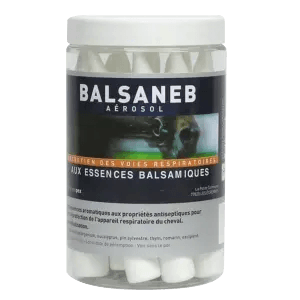
Balsaneb - Aerosol - Respiratory care for horses - Nebulisation - 14 x 10 ml - GREENPEX
In stock
22,83 €
Unavailable in your country

We do not currently ship to your country (États-Unis).
Free shipping from €99
In mainland France
Dispatched within 24h
From the Pharmacie de l'Envigne (86)
Delivery within 2 to 4 days
In mainland France
Secure payment
Encrypted transaction
ANSES-approved pharmacy
Advice from qualified pharmacists
Managing equine health often requires a regular and sustained approach. The 5 kg size of Horse Master garlic semolina perfectly meets the needs of stables. It is also suitable for owners with several horses. This large size allows complete courses to be carried out without running out of stock. You therefore make substantial savings on the daily cost of the supplement.
The sturdy bucket ensures optimal preservation of the product in the tack room. The garlic retains all its freshness and active properties, protected from humidity. Moreover, the semolina texture remains fluid and easy to dose on a daily basis. It does not clump together like some fine powders. It is the ideal solution for durably integrating phytotherapy into your horses' routine.
The effectiveness of this product is based on the quality of the plant used. The garlic selected by Horse Master is rich in sulphur and allicin. These components play a key role in the horse's respiratory comfort. They act as a natural cleanser of the bronchi. The horse expels secretions more easily during work. This is valuable for horses living in dusty boxes.
Furthermore, garlic semolina vigorously stimulates blood circulation. Better irrigation promotes the proper functioning of muscles and joints. This internal action has a highly appreciated external consequence. The modification of the sweat's odour naturally repels biting insects. Flies and horseflies harass your horse less in the field or at work. It is an effective natural barrier that complements classic external sprays.
Adopting the 5 kg bucket offers major advantages for managing your herd:
Garlic is beneficial, but its administration requires a certain vigilance over time. Experts generally recommend proceeding in courses rather than continuously. An ideal use consists of giving garlic semolina for three weeks, followed by a one-week break. This rhythm allows the body to assimilate the benefits without overload. Indeed, garlic contains N-propyl disulfide. At very high doses and over a very long period, this molecule can affect red blood cells. Respecting the course cycles guarantees total safety and maximum effectiveness for your horse.
The choice between powder and semolina often depends on the horse's tolerance and practicality. Garlic powder has the same nutritional virtues as semolina. However, it is much more volatile. It can irritate sensitive nostrils when the horse plunges its head into the manger. Garlic semolina avoids this drawback thanks to its larger grain size. It binds better with cereals or pellets, especially if lightly moistened. For a large 5 kg size, semolina often remains more pleasant for the caretaker to handle on a daily basis.
Garlic acts as a systemic repellent, meaning it acts from the inside out. During digestion, the sulphur compounds pass into the blood. They are then eliminated through the animal's perspiration. This subtle odour, imperceptible to humans, strongly displeases blood-feeding insects. Ticks, mosquitoes and horse flies tend to avoid the skin of treated horses. Moreover, garlic has sanitising properties for the digestive tract. It creates an environment unfavourable to the development of certain intestinal parasites, although it does not replace a veterinary chemical wormer.
Absolutely, this is one of the main indications for this feed supplement. The expectorant properties of garlic are well documented in equine phytotherapy. It helps to thin the mucus present in the trachea and lungs. This allows the horse to expel impurities more effectively when it starts moving. For a horse suffering from seasonal respiratory allergies or irritations due to hay dust, garlic semolina provides notable relief. It also strengthens the local immune defences of the respiratory tract against external aggressions.
L'ail est bénéfique, mais son administration demande une certaine vigilance sur la durée. Les experts recommandent généralement de procéder par cures plutôt qu'en continu. Une utilisation idéale consiste à donner de l'ail semoule pendant trois semaines, suivie d'une pause d'une semaine. Ce rythme permet à l'organisme d'assimiler les bienfaits sans surcharge. En effet, l'ail contient du disulfure de N-propyle. À très haute dose et sur une très longue période, cette molécule peut affecter les globules rouges. Le respect des cycles de cures garantit une sécurité totale et une efficacité maximale pour votre cheval.
Le choix entre poudre et semoule dépend souvent de la tolérance du cheval et de la praticité. La poudre d'ail possède les mêmes vertus nutritionnelles que la semoule. Cependant, elle est beaucoup plus volatile. Elle peut irriter les naseaux sensibles lorsque le cheval plonge la tête dans la mangeoire. L'ail semoule évite cet inconvénient grâce à sa granulométrie plus importante. Elle se lie mieux aux céréales ou aux granulés, surtout si on l'humidifie légèrement. Pour un grand format de 5 kg, la semoule reste souvent plus agréable à manipuler au quotidien pour le soigneur.
L'ail agit comme un répulsif systémique, c'est-à-dire qu'il agit de l'intérieur vers l'extérieur. Lors de la digestion, les composés soufrés passent dans le sang. Ils sont ensuite évacués par la transpiration de l'animal. Cette odeur subtile, imperceptible pour l'homme, déplaît fortement aux insectes hématophages. Les tiques, les moustiques et les mouches plates ont tendance à éviter la peau du cheval traité. De plus, l'ail possède des vertus assainissantes pour le tube digestif. Il crée un environnement défavorable au développement de certains parasites intestinaux, bien qu'il ne remplace pas un vermifuge chimique vétérinaire.
Absolument, c'est l'une des indications principales de ce complément alimentaire. Les propriétés expectorantes de l'ail sont bien documentées en phytothérapie équine. Il aide à fluidifier le mucus présent dans la trachée et les poumons. Cela permet au cheval d'expulser les impuretés plus efficacement lorsqu'il se met en mouvement. Pour un cheval souffrant d'allergies respiratoires saisonnières ou d'irritations dues à la poussière de foin, l'ail semoule apporte un soulagement notable. Il renforce également les défenses immunitaires locales des voies respiratoires face aux agressions extérieures.