LABORATOIRE COMBE D'ASE
(1)
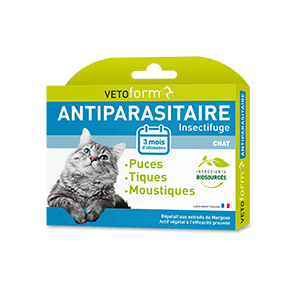
Insect repellent parasiticide - 3 pipettes - Cat - VETOFORM
In stock
10,42 €
Unavailable in your country
We do not currently ship to your country (États-Unis).
Free shipping from €99
In mainland France
Dispatched within 24h
From the Pharmacie de l'Envigne (86)
Delivery within 2 to 4 days
In mainland France
Secure payment
Encrypted transaction
ANSES-approved pharmacy
Advice from qualified pharmacists
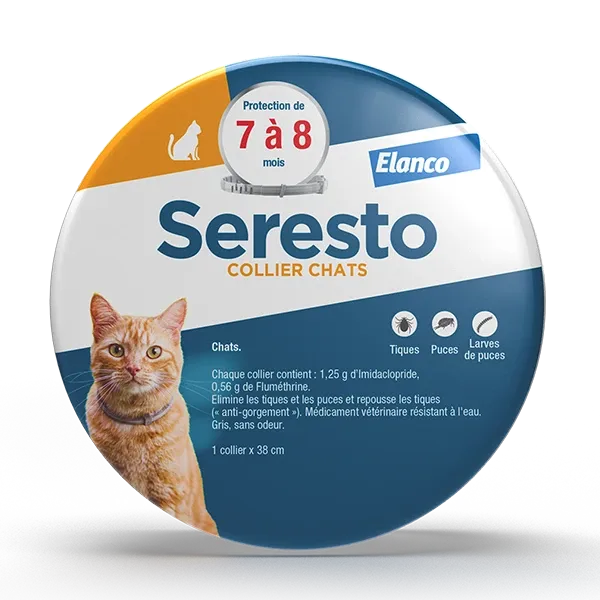
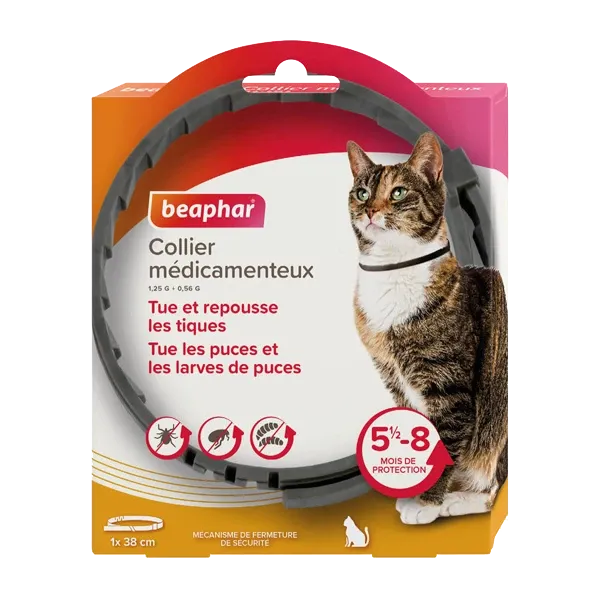
The BEAPHAR antiparasitic cat collar is a veterinary medicine for mixed infestations by fleas and ticks. It treats fleas for 5.5 months and prevents new tick infestations for up to 8 months. This 38 cm collar is suitable for cats over 10 weeks of age.
Are you looking for continuous protection against fleas and ticks? This antiparasitic collar progressively releases two active substances onto the skin and coat.
The formula combines imidacloprid and flumethrin. These substances exert complementary actions against the cat’s external parasites.
Imidacloprid has insecticidal activity against fleas. Flumethrin provides acaricidal and repellent activity against ticks.
However, the durations of protection are not identical. The insecticidal action against fleas lasts 5.5 months. The action against ticks continues for up to 8 months.
The veterinary medicine also protects the immediate environment against the development of flea larvae for 10 weeks. This activity particularly concerns areas frequented by the cat.
The collar may also be part of a control programme for flea allergy dermatitis. This condition nevertheless requires a veterinary assessment.
The product has a secure release mechanism. In addition, it remains odourless and is resistant to moderate exposure to water.
Each grey collar of 38 cm weighs 12.5 g and contains:
The collar matrix also includes polyvinyl chloride, dibutyl adipate and epoxidised soybean oil. It also contains stearic acid and colourants.
Imidacloprid is an external antiparasitic from the chloronicotinyl family. It acts against adult fleas and their larvae.
This substance binds to the parasite’s nicotinic acetylcholine receptors. It then disrupts the transmission of nerve signals.
This action leads to paralysis, then death of the fleas. The collar’s insecticidal activity against Ctenocephalides felis continues for 5.5 months.
The product also limits the development of larvae in the immediate environment for 10 weeks. However, it does not fully treat an already heavily infested home.
Eggs and larvae may be found in baskets, rugs or sofas. Therefore, regular maintenance of the environment remains important.
Flumethrin is an external antiparasitic belonging to synthetic pyrethroids. It mainly acts against ticks.
This substance disrupts the sodium channels of the parasite’s nerve cells. It thus delays nerve repolarisation and causes the tick’s death.
Flumethrin exerts an acaricidal action against Ixodes ricinus. This effect becomes active within nine days of placement.
It also has a repellent action, known as anti-feeding. This activity begins within two days and continues for up to eight months.
The collar acts against larvae, nymphs and adult ticks. However, tick attachment remains possible despite the treatment.
Thus, the risk of transmission of an infectious agent can never be completely excluded.
Imidacloprid and flumethrin are incorporated into the collar’s polymer matrix. They are then released slowly and continuously.
The two substances spread from the neck across the entire skin surface. They remain present on the coat at low active concentrations.
This diffusion provides lasting protection without daily administration. The collar must nevertheless remain properly fitted to the cat’s size.
Periods of heavy shedding may temporarily reduce its effectiveness. The diffusion of the substances then resumes without additional treatment.
The BEAPHAR collar simultaneously targets fleas and ticks. The SPC therefore reserves its use for cats infested or exposed to both parasites.
In the absence of a combined risk, an antiparasitic with a narrower spectrum may be preferable. This approach limits unjustified use of active substances.
Indeed, inappropriate use can increase the selection pressure for resistance. The choice should therefore take into account the cat’s lifestyle and exposure.
An outdoor animal does not always present the same risks as an indoor cat. The season and region also influence exposure.
If in doubt, ask your veterinarian for advice.
The collar is not suitable for kittens under 10 weeks of age. Its use is also not recommended during pregnancy and lactation.
Local reactions may appear in some animals. These may take the form of redness, itching or hair loss.
More rarely, digestive or behavioural disorders may occur. Remove the collar and contact a veterinarian in the event of a significant reaction.
The BEAPHAR antiparasitic cat collar combines an insecticidal action against fleas and an acaricidal action against ticks.
Imidacloprid eliminates fleas for 5.5 months. It also limits the development of their larvae in the environment for 10 weeks.
Flumethrin kills and repels ticks for up to 8 months. It acts against larvae, nymphs and adult parasites.
The 38 cm collar has a secure fastening. It is suitable for cats over 10 weeks of age simultaneously exposed to fleas and ticks.
The best antiparasitic collar depends on the targeted parasites, the cat’s age and its environment. No single model is automatically suitable for every animal.
The BEAPHAR collar addresses simultaneous risks of fleas and ticks. It acts for 5.5 months against fleas and up to 8 months against ticks.
A plant-based repellent collar does not necessarily have the same indications as a veterinary medicine. Therefore, compare the active substances, durations and contraindications.
A flea collar can be considered before periods when the cat is likely to encounter parasites. Fleas can, however, remain present all year round in heated homes.
The BEAPHAR collar is suitable when the risk concerns fleas and ticks simultaneously. It is ideally used before the start of their activity season.
It is not suitable for kittens under 10 weeks of age. Seek veterinary advice when the cat is ill, pregnant, nursing or particularly sensitive.
A collar can be suitable for a cat when it is adapted to its species and has a safety system. The BEAPHAR model incorporates a mechanism designed to loosen if caught.
The cat’s skin and behaviour should nevertheless be monitored. Redness, hair loss or itching may indicate a local reaction.
The cat must also tolerate wearing an accessory around its neck. Another antiparasitic format may be chosen if it persistently refuses the collar.
The best antiparasitic is the one that matches the parasites present or the real risk of infestation. Pipettes, tablets, sprays and collars do not all have the same spectrum.
The BEAPHAR collar jointly targets fleas and ticks. It offers prolonged action, without monthly renewal during its periods of effectiveness.
However, another veterinary medicine may be more suitable in the case of a flea-only infestation. The veterinarian can guide the choice according to the cat’s profile.