AUDEVARD
(2)
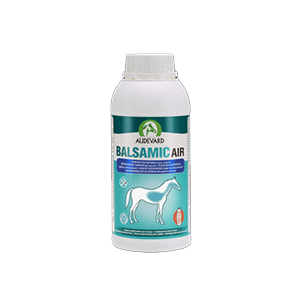
Balsamic Air - Respiratory Tract - Horse - 500 ml - AUDEVARD
In stock
30,81 €
Unavailable in your country
We do not currently ship to your country (États-Unis).
Free shipping from €99
In mainland France
Dispatched within 24h
From the Pharmacie de l'Envigne (86)
Delivery within 2 to 4 days
In mainland France
Secure payment
Encrypted transaction
ANSES-approved pharmacy
Advice from qualified pharmacists
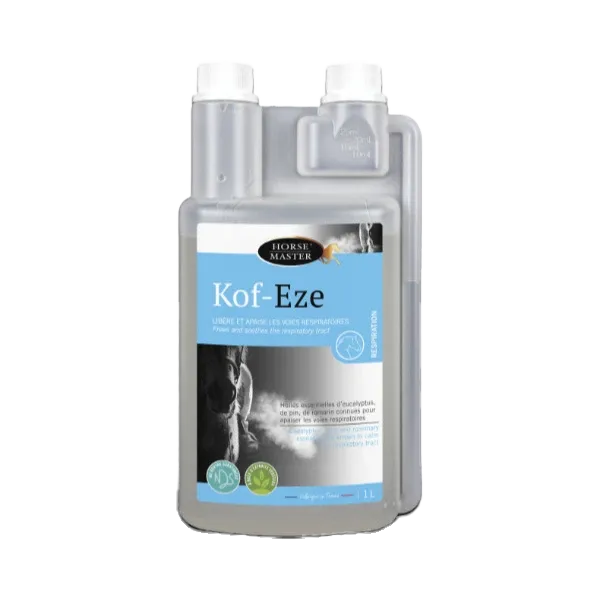
Kof-Eze from the laboratory Horse Master is a complementary feed formulated to support horse cough and maintain respiratory tract comfort. Horse cough can appear when exposed to dust, pollen, mould in forage, or an insufficiently ventilated environment. It can also occur during climatic variations or during periods of seasonal respiratory sensitivity.
Equine airways are sensitive to fine particles inhaled both in the box and in the paddock. In this context, suitable nutritional support helps maintain normal respiratory function and bronchial comfort.
Kof-Eze can be administered directly in the daily feed ration. Its liquid form makes distribution easier and allows precise adjustment for each horse.
This supplement can also be used by nebulization, according to the manufacturer's recommendations. Nebulization consists of diffusing a solution as an aerosol using a suitable equine nebulizer. This technique allows direct diffusion to the respiratory tract, particularly at the bronchial level.
Use by nebulization can be part of an overall strategy for managing horse cough, in addition to improving the environment and veterinary follow-up if necessary. The equipment used must be compatible with equine use and comply with the manufacturer's recommendations.
Suitable care helps maintain functional breathing and support the horse during periods of respiratory sensitivity.
To soothe horse cough, it is essential to act on the environment. Effective ventilation and reducing dust in bedding and hay are priority measures. Hay can be dampened to limit the inhalation of irritating particles.
In addition, respiratory support can be administered in the feed ration or by nebulization. In case of persistent or worsening cough, a veterinary consultation makes it possible to identify the precise cause.
Stopping horse cough depends on its origin. An environmental cough requires an adaptation of living conditions. An inflammatory or infectious condition requires a veterinary diagnosis and suitable care.
A respiratory supplement can support natural mechanisms. Nebulization is also an option in certain respiratory management strategies, under suitable supervision.
Bronchitis in horses can manifest as frequent coughing, breathing discomfort and reduced performance during exercise. Nasal discharge may be observed. Faster or noisier breathing may also appear.
These signs should lead to a veterinary evaluation in order to adapt care. Horse cough must always be analysed within its overall clinical context.
Pour calmer la toux du cheval, il est essentiel d’agir sur l’environnement. Une ventilation efficace et la réduction des poussières dans la litière et le foin constituent des mesures prioritaires. Le foin peut être humidifié afin de limiter l’inhalation de particules irritantes.
En complément, un soutien respiratoire peut être administré dans la ration ou par nébulisation. En cas de toux persistante ou aggravée, une consultation vétérinaire permet d’identifier la cause précise.
L’arrêt de la toux du cheval dépend de son origine. Une toux environnementale nécessite une adaptation des conditions de vie. Une atteinte inflammatoire ou infectieuse requiert un diagnostic vétérinaire et une prise en charge adaptée.
Un complément respiratoire peut accompagner les mécanismes naturels. La nébulisation constitue également une option dans certaines stratégies de gestion respiratoire, sous encadrement adapté.
La bronchite chez le cheval peut se manifester par une toux fréquente, une gêne respiratoire et une baisse des performances à l’effort. Des écoulements nasaux peuvent être observés. Une respiration plus rapide ou plus bruyante peut également apparaître.
Ces signes doivent conduire à une évaluation vétérinaire afin d’adapter la prise en charge. La toux du cheval doit toujours être analysée dans son contexte clinique global.