AUDEVARD
(2)
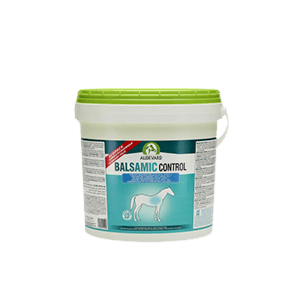
Balsamic Control - Respiratory tract comfort - 5 kg - AUDEVARD
In stock
224,55 €
Unavailable in your country

We do not currently ship to your country (États-Unis).
Free shipping from €99
In mainland France
Dispatched within 24h
From the Pharmacie de l'Envigne (86)
Delivery within 2 to 4 days
In mainland France
Secure payment
Encrypted transaction
ANSES-approved pharmacy
Advice from qualified pharmacists
Or Broncho Nebu is a solution designed to support horse respiratory comfort as part of an overall care approach. It is intended for horses with sensitive airways, exposed to dust, weather changes or confined environments. The product fits into a reasoned respiratory management approach. It complements stable hygiene measures and veterinary follow-up. This solution is used by nebulisation in order to finely diffuse its aromatic components. The aim is to support the horse's breathing in a gentle and controlled way.
The formulation of Or Broncho Nebu is based on a rigorous selection of aromatic components. These elements are suited to diffusion by nebulisation. This method allows for even distribution in the upper respiratory tract. The solution is not intended to have a medicinal effect. It is part of an approach to support horse respiratory comfort. Nebulisation is often preferred to limit systemic ingestion. It promotes a local action, integrated into a respiratory care routine.
Or Broncho Nebu is developed by OR VET, a laboratory specialising in natural and functional solutions for horses. OR VET products meet high standards of quality and traceability. The brand is aimed at owners who care about equine well-being. It offers complementary solutions, designed to support common issues in athletic or leisure horses. Or Broncho Nebu is part of this approach, targeting horse respiratory comfort.
Improving a horse's breathing relies on an overall approach. The environment plays a major role. Good stable ventilation limits exposure to dust. Choosing a low-dust bedding is essential. Feed must also be adapted. In addition, nebulisation solutions can support horse respiratory comfort. They fit into a routine supervised by a veterinarian. This combination of measures promotes more comfortable breathing on a daily basis.
Respiratory problems in horses can show up in different ways. Repeated coughing often appears during exercise or at rest. Nasal discharge may be observed. The horse may show a drop in performance. Louder or faster breathing is also a warning sign. These signs should lead to a veterinary evaluation. Targeted support for horse respiratory comfort can then be considered depending on the diagnosis.
Breathing difficulty shows up as visible respiratory effort. The horse may flare its nostrils. Flank movements become more pronounced. Exercise intolerance may appear. In some cases, the animal seems more tired. These symptoms require prompt attention. Complementary solutions, such as nebulisation, may be included in the follow-up, always under veterinary supervision, in order to support horse respiratory comfort.
L’amélioration de la respiration du cheval repose sur une approche globale. L’environnement joue un rôle majeur. Une bonne ventilation des écuries limite l’exposition aux poussières. Le choix d’une litière peu poussiéreuse est essentiel. L’alimentation doit également être adaptée. En complément, des solutions de nébulisation peuvent accompagner le confort respiratoire cheval. Elles s’intègrent dans une routine encadrée par un vétérinaire. Cette combinaison de mesures favorise une respiration plus confortable au quotidien.
Les problèmes respiratoires chez le cheval peuvent se manifester de différentes façons. Une toux répétée apparaît souvent à l’effort ou au repos. Des écoulements nasaux peuvent être observés. Le cheval peut montrer une baisse de performance. Une respiration plus bruyante ou accélérée alerte également. Ces signes doivent conduire à une évaluation vétérinaire. Un accompagnement ciblé du confort respiratoire cheval peut alors être envisagé selon le diagnostic.
Une difficulté respiratoire se traduit par un effort respiratoire visible. Le cheval peut écarter les naseaux. Les mouvements du flanc deviennent plus marqués. Une intolérance à l’exercice peut apparaître. Dans certains cas, l’animal semble plus fatigué. Ces symptômes nécessitent une prise en charge rapide. Des solutions complémentaires, comme la nébulisation, peuvent s’inscrire dans le suivi, toujours sous contrôle vétérinaire, afin de soutenir le confort respiratoire cheval.