GREENPEX
(12)
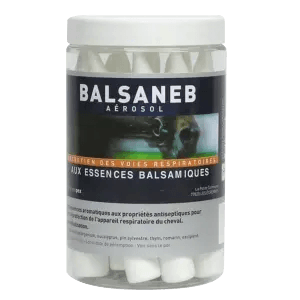
Balsaneb - Aerosol - Respiratory care for horses - Nebulisation - 14 x 10 ml - GREENPEX
In stock
22,83 €
Unavailable in your country
We do not currently ship to your country (États-Unis).
Free shipping from €99
In mainland France
Dispatched within 24h
From the Pharmacie de l'Envigne (86)
Delivery within 2 to 4 days
In mainland France
Secure payment
Encrypted transaction
ANSES-approved pharmacy
Advice from qualified pharmacists
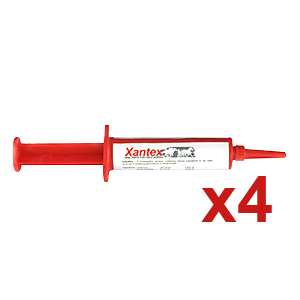
Xantex is a supplement intended for horses, developed by the FARNAM laboratory, recognized for its expertise in equine nutrition and care. It is specifically formulated to support horses prone to equine pulmonary hemorrhage, also known as EIPH (exercise-induced pulmonary hemorrhage).
This issue mainly affects horses subjected to intense efforts, particularly in competition. During significant exertion, the pressure exerted on the pulmonary capillaries can lead to micro-ruptures, responsible for internal bleeding. Xantex is part of an approach aimed at preserving pulmonary vascular integrity.
Equine pulmonary hemorrhage can impact sporting performance and respiratory comfort. Even when clinical signs are subtle, the consequences on oxygenation and recovery can be significant. Xantex is used to support at-risk horses, particularly before or after sustained exertion.
Presented as oral syringes, Xantex allows for precise and practical administration. This format is suited to occasional use or integration into an overall management strategy for the sport horse, under veterinary supervision.
The management of equine pulmonary hemorrhage relies on a multifactorial approach. It includes training management, environmental factors, as well as veterinary monitoring. Xantex serves as a targeted nutritional support, complementing the measures put in place to limit excessive strain on the respiratory system.
Its use is part of a prevention and support approach, particularly in horses known to experience bleeding episodes during exertion.
The management of a horse presenting with pulmonary hemorrhage relies on a precise veterinary diagnosis. It includes adapting training, managing exertion and, if necessary, using support solutions such as Xantex. The goal is to limit the pressure exerted on the pulmonary capillaries and support respiratory function.
The symptoms of equine pulmonary hemorrhage can be subtle. A decrease in performance, slower recovery or respiratory discomfort may be observed. In some cases, a bloody discharge from the nostrils appears after exertion. Only a veterinary examination can confirm the diagnosis.
Pulmonary hemorrhages are mainly linked to intense exertion causing a significant increase in blood pressure in the pulmonary capillaries. Factors such as exercise intensity, conformation, age or the horse's sporting history can contribute to their occurrence.
The causes are mostly mechanical and linked to exertion. Treatments rely on adapted management of the horse, regular veterinary monitoring and the use of targeted support solutions. Xantex is part of this overall approach, supporting the measures put in place to preserve respiratory health.
La prise en charge d’un cheval présentant une hémorragie pulmonaire repose sur un diagnostic vétérinaire précis. Elle inclut l’adaptation de l’entraînement, la gestion de l’effort et, si nécessaire, l’utilisation de solutions de soutien comme Xantex. L’objectif est de limiter la pression exercée sur les capillaires pulmonaires et d’accompagner la fonction respiratoire.
Les symptômes d’une hémorragie pulmonaire du cheval peuvent être discrets. Une baisse de performance, une récupération plus lente ou une gêne respiratoire peuvent être observées. Dans certains cas, un écoulement sanguinolent par les naseaux apparaît après l’effort. Seul un examen vétérinaire permet de confirmer le diagnostic.
Les hémorragies pulmonaires sont principalement liées à des efforts intenses provoquant une élévation importante de la pression sanguine dans les capillaires pulmonaires. Des facteurs comme l’intensité de l’exercice, la conformation, l’âge ou l’historique sportif du cheval peuvent favoriser leur apparition.
Les causes sont majoritairement mécaniques et liées à l’effort. Les traitements reposent sur une gestion adaptée du cheval, un suivi vétérinaire régulier et l’utilisation de solutions de soutien ciblées. Xantex s’intègre dans cette approche globale, en accompagnement des mesures mises en place pour préserver la santé respiratoire.