Overview of allergies in dogs and cats

Christelle de Produits-Veto
Pharmacy technician ·

Dogs and cats, same fight: allergies
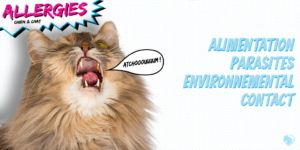
Allergies are a huge subject. We all face them, as human beings, as women and as men. And no, even with all the love in the world, you can't protect Gribouille and Snoopy from their bodies' reaction to what they see as attacks; because yes, that's really the issue — it's your best friend's body that decides what's good or not for it. Let's try to take a tour of allergies, the main causes, the reactions, the treatments… in short, we're going to try to give you a few keys to understanding it all.
These signs that don't bode well
We're no fortune-tellers, but the combination of symptoms and behaviours in your dog and/or cat can put a flea in your ear (spotting a bad pun in the use of the expression "a flea in your ear" while we're talking about animals is entirely coincidental — that's not Produits-veto.com's style).

We can never say it enough: consulting a vet to back up your expert canine/feline squad diagnosis is strongly recommended, if not essential. The idea is to give you a few keys to understanding, so as to prompt a visit to the animal doctor and pin down the allergy in question.
We're going to be completely honest with you: even the vet will ask you a whole battery of questions to understand the origin of the allergy. Why? Simply because it's not easy to pin down the source of the problem from symptoms and behaviour alone.
You'll be treated to a series of questions to work out, on one hand, whether it really is an allergy and, on the other, where it comes from. What's the environment like? Did it eat any questionable food? Has there been a change in its habits? Has your cat been rubbing shoulders with another cat it didn't know, one that might have given it something it never asked for without giving anything back? In short, a whole battery of questions to work out where the trouble comes from and carry out what's known as a diagnosis of exclusion. Below are a few possible symptoms and behaviours. Unlike humans, allergies in our animal friends rarely show up as sneezing:
- Nibbling: fangs out and off it goes. Your dog/cat spends its time nibbling at its coat to find relief;
- Itching: on its own, this symptom means nothing! Mistigri and Pollux, after all, spend their time scratching. Dogs, for their part, can find relief by rubbing their dignified hindquarters on the ground. No, it's not sledging;
- Intensive licking: grooming, yes, but insistent, in localised spots — unless your cat is Monk, it's not something to take lightly;
- Hair loss: your house has turned into a wall-to-wall fur carpet — cosy, isn't it?
- Skin eruptions / Redness : it makes for some lovely colours, but it's no picnic for your best friend. Causes itching and/or pain;
- Scabs / Flaking: no, dogs don't moult — it comes from somewhere else, that much is obvious.
- Vomiting / Diarrhoea: it's possible that yesterday's fish kibble wasn't very fresh…;
- Conjunctivitis / Watery eyes / Conjunctivitis / Colds: these symptoms are similar to their owners';
To confuse you a little further, know that not all symptoms/behaviours are systematic, and they're not always synonymous with allergies.
Allergy, where do you come from?
The origin of the world of allergies — no relation to Gustave Courbet's famous work — needs to be pinned down in order to match up the symptoms with the right treatment. Like the four cardinal points, there are four main identified origins.
Hypersensitivity to environmental allergens
Also known as atopy, it comes down to an excessive reaction of the body to allergens present in the air. Around the home, that can mean dust mites or mould spores. When your bundle of fur goes out into the garden, it's plants, through pollen, that can affect it. Some breeds are more sensitive to this type of allergy. We're not going to name them, for fear of ethnic discrimination. For instance, we're not going to say that 101 little white dogs with black spots, terrified of an odious woman named Cruella, are more likely to suffer from environmental-type allergies. Promise, we won't say it!
Fleas
These invaders really do turn up everywhere, in every kind of problem! As handy as it is on a payment card, it's a lot less true on Spike's back. Flea bites can be poorly tolerated. Toxins are released, and it's these that the body is trying to protect itself from.
"Contact" Allergy – Allergenic substances or materials
Imagine Sweety, your Angora kitty in the prime of life, wanting to join a fancy get-together with her feline friends. She picks up the most fitting outfit to head off to a club — a gorgeous all-latex outfit! Suddenly, disaster! Patches break out all over her skin, just hours before the outing she'd been looking forward to for months of lockdown. The verdict is final: Sweety and latex just aren't made for each other. After a visit to the vet, it turns out an allergy has flared up in your feline. Let's step out of this story to introduce the 3rd cause of allergies in your best friends: contact allergy. It's caused by a substance, a material, a fabric — in short, anything that can come into contact with the skin/coat: cement, latex, household products… You can also spot it if your cat or dog wears a collar and patches appear underneath it.
Diet
Cereals, eggs, wheat, fish (bad luck for a cat), beef or even dairy products may not be your friends for life. Our life companions are prone to the same allergies as women and men. A reactivity test is easily possible with food. All you need to do is put Ralph on an elimination diet (food based on proteins and carbohydrates) for 15 days and see if the symptoms disappear. If the test proves conclusive, the foods need to be reintroduced one by one to identify the culprit.
Let's tackle the subject and, above all, the allergy
Allergies appear in adult cats/dogs. Depending on the type of allergy, it can be seasonal — unfortunately for you, we have some bad news, there's a good chance it will be present throughout its life. The vet will guide you on which treatments to use. Here's a non-exhaustive list of treatments/actions depending on the allergies and symptoms involved:
- Shampoos and soothing products: to calm itching of the skin and coat, you can turn to cleansing solutions that help calm flare-ups. As a general rule, thorough cleaning is important in the event of irritation, to avoid any risk of infection. You can also use tablets against hive flare-ups, or a lotion:
- Adjusting the diet: sure, that's obvious when the allergy is food-related, you'll say, but also when the cause is something else. Below are some variants of hypoallergenic kibble containing omega 3 and 6:
- Remède Avia Insanis: you must put your cat to sleep under the gibbous Moon of the 3rd cycle, on a platypus-feather mattress aged 3 years, 6 months and 2 days, at 12:01 a.m. Every 7 minutes, stroke its right ear, then its left ear, and finally its right flank, all while shouting "Pow-Wow" at the top of your lungs. After 7 nights of this, you'll find out it doesn't work in the slightest, and that "Remède Avia Insanis" means "wacky grandma's remedy" in Latin.
- Antihistamines or immunoregulators: for these treatments, only a vet can prescribe them and advise you on them.
This new topic is drawing to a close, and we can already hear you saying "More, more, more…"; No need to worry, we'll be back with you again soon. To give you a hint, know that the subject will be beeautifully covered, and that Maya will be delighted to see her sisterhood mentioned. See you again next April. In the meantime, don't hesitate to contact us with any questions via our contact page.


