How to naturally soothe a sensitive ovarian mare?

Christelle de Produits-Veto
Pharmacy technician ·

A sensitive ovarian mare: what does that really mean?
An ovarian mare is a mare whose behaviour, comfort or performance seem to vary with her ovarian cycle. She may become irritable, sensitive to grooming, less available for work or painful during heat. Are you wondering whether your mare is being difficult or whether she is really in pain? In many cases, the answer lies somewhere in between: hormones affect her comfort, but pain must always be taken seriously.
In mares, the sexual cycle lasts 21 days on average. The heat period, also called oestrus, often lasts 5 to 7 days. It corresponds to a phase in which the mare accepts the stallion and the ovary prepares for ovulation. However, every mare reacts differently. Some show almost no signs at all. Others display very marked mare behaviour: raised tail, urine spraying, vulvar winking, restlessness, back stiffness, girthiness or refusal to move forward.
The aim is therefore not to systematically suppress heat cycles. It is rather about identifying abnormal signs, reducing discomfort and choosing a suitable solution. Good news: a well-conducted natural approach can already improve many mild to moderate situations.
Ovarian mare and mare heat: why hormonal comfort matters
Hormonal comfort directly influences movement, mental availability and the relationship with the rider.
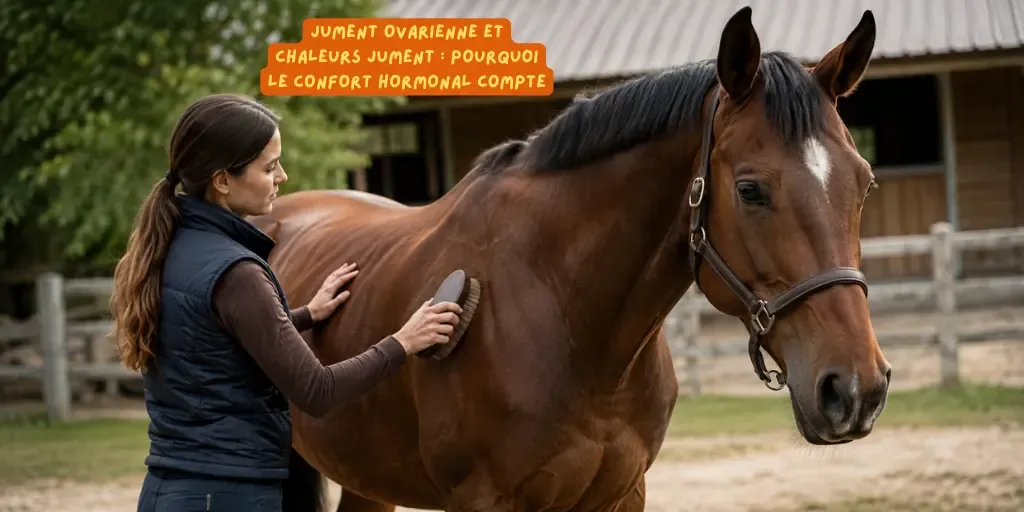
Why is a sensitive ovarian mare important for the horse?
A mare that is sensitive at the ovarian level may associate certain handling with genuine discomfort. Grooming the flank, leg pressure, the saddle or the girth then become triggers. Then, even once the pain decreases, anticipation can keep the defensive behaviour going.
In a sport mare, this can translate into a drop in performance. In a leisure mare, the owner often observes an alternation of good and bad days. This is why it is necessary to think globally: the ovaries are not always the only ones responsible.
Difficult behaviour can also come from a gastric ulcer, back pain, a poorly fitted saddle, mild lameness, a dietary imbalance or chronic stress. A so-called ovarian mare should therefore be observed, then examined if the signs persist.
Causes, symptoms and issues associated with mare heat
Mare heat corresponds to a normal phase of the cycle. However, it becomes problematic when it is accompanied by pain or significant changes. The most common signs are:
- irritability in the stable, in the field or during grooming;
- sensitivity of the flanks, back or lumbar area;
- repeated urine spraying and raised tail;
- vulvar contractions, known as winking;
- refusing the leg or resisting under the saddle;
- loss of energy, lack of concentration or restlessness;
- excessive attachment to other horses;
- stronger reactions near geldings or stallions.
True ovarian pain can be linked to ovulation, a large follicle, an anovulatory follicle, a cyst or, more rarely, an ovarian tumour. Granulosa-theca cell tumour remains rare, but it should be considered if the mare shows permanent heat, unusual aggressiveness, masculinisation of behaviour or ovarian asymmetry.
On the other hand, a mare that pins her ears during girthing is not necessarily ovarian. The sign is useful, but it is not specific. This is why observation over several cycles provides valuable information.
Recommended veterinary solutions before supplementing
The first solution is to check that the mare is not suffering from a condition requiring a diagnosis.
When the signs are marked, the veterinarian may suggest transrectal palpation, an ovarian and uterine ultrasound, or even a hormonal panel. These examinations make it possible to visualise the follicles, the corpus luteum, the uterus and the size of the ovaries. Depending on the context, they also help distinguish a normal cycle from an ovarian abnormality.
Veterinary references, including the Merck Veterinary Manual and publications from the American Association of Equine Practitioners, note that cycle suppression can be considered in certain mares. It mainly relies on prescribed hormonal treatments, such as progestogens. These solutions should never be given without follow-up, as they have indications, limitations and handling precautions.
If in doubt, consult your veterinarian before any treatment.
For a natural approach, the priorities are simple:
- stabilise the mare's social environment;
- adapt work during sensitive days;
- avoid sudden changes in feeding;
- support muscular and nervous comfort;
- choose a targeted, traceable supplement suited to the horse.
Plants used for hormonal comfort often include chasteberry, yarrow, chamomile, lemon balm or raspberry leaves. They can help some mares, but they do not replace a diagnosis. In addition, pregnant, lactating or breeding mares require particular caution.
Original insight: the 28-day monitoring chart to objectify mare behaviour
The best practical advice is to measure before acting.
Many owners say: my mare is unbearable in spring. However, without monitoring, it becomes difficult to know whether the problem recurs every 21 days, after a change of ration, at competition time or only with a particular saddle.
So use a simple chart for 28 days. Note four criteria each day, from 0 to 3:
| Criterion | 0 | 1 | 2 | 3 |
|---|---|---|---|---|
| Acceptance of grooming | normal | slight discomfort | clear resistance | danger or marked pain |
| Girthing and saddling | no reaction | ears pinned | biting or moving away | refusal or strong resistance |
| Ridden work | available | a little stiff | regular opposition | work impossible |
| Signs of heat | absent | discreet | frequent | permanent or excessive |
Also add the date, type of work, weather, contact with other horses, the ration and stressful events. After four weeks, look at the profile. If the scores increase for 5 to 7 days then decrease, the hormonal explanation becomes consistent. If the scores remain high continuously, another cause should be sought.
This method avoids two common mistakes: treating too quickly a mare that mainly has back pain, or dismissing ovarian pain that deserves an ultrasound.
How to soothe an ovarian mare naturally on a daily basis
An effective natural approach combines management, feeding, work and reasoned supplementation.
Adapting the environment and the group
Social stability helps many sensitive mares. Changes of field, repeated separations or the permanent presence of a stallion can amplify the signs. If possible, keep a calm group, with compatible companions. Also avoid unnecessary back-and-forth between isolation and the herd.
In the stable, increase turnout and access to forage. A mare that moves more often manages muscular tension better. In addition, hay available at will or given in very small portions limits stress peaks and supports digestive balance.
Adjusting work during sensitive days
Calming an ovarian mare does not mean leaving her without structure. However, the workload must be adapted.
Favour long warm-ups, active walk, straight lines and simple exercises. Temporarily reduce demanding lateral work if the mare protects her flanks. Avoid punitive sessions, as they reinforce defensive behaviour. You can also replace a demanding session with groundwork, a quiet walk or a short, calm lunging session.
Are you wondering whether you should ride during heat? Yes, if the mare remains comfortable and available. No, or differently, if she shows clear pain, unusual stiffness or a danger for the rider.
Supporting diet and the nervous system
Diet influences muscle tone, inflammation and nervousness.
Excess starch can increase excitability in some horses. Conversely, a fibre-rich ration, with balanced mineral intake, promotes better stability. Magnesium can be worthwhile when the mare shows nervousness, muscular tension or hypersensitivity. Omega-3s, from flaxseed for example, also support overall inflammatory balance.
However, be careful with multiple combinations. Adding three supplements at once makes it impossible to know what is working. Introduce one solution for 3 to 4 weeks, then assess using your monitoring chart.
Using plants with caution
Herbal medicine can support a sensitive ovarian mare, especially when the signs remain moderate.
Chasteberry is often used for hormonal balance. Chamomile and lemon balm support relaxation. Raspberry leaves are traditionally used for comfort of the reproductive system. However, natural does not mean harmless. Some plants may be discouraged for breeding, during pregnancy or before an official competition.
If your mare competes, always check the composition and the rules in force. If in doubt, ask for veterinary advice or contact the manufacturer. This precaution avoids unpleasant surprises during an anti-doping control.
Benefits of veterinary products for a sensitive ovarian mare
The associated veterinary products aim to support the mare's comfort and behavioural balance during periods of sensitivity linked to the cycle. They do not replace a veterinary diagnosis when pain or an ovarian abnormality is suspected.
Ovary Stab: support for the behaviour of sensitive mares

- designed for mares prone to pronounced ovarian cycle disorders;
- helps improve comfort during sensitive periods;
- liquid formula based notably on turmeric and magnesium;
- suited to support during the ovarian season.
Ovary Stab is a complementary feed developed by HORSE MASTER for mares whose ovarian cycle disorders may disrupt behaviour or performance. Its formula contains notably turmeric, magnesium sulfate and magnesium chloride.
Calovet: comfort for mares prone to ovarian disorders

- supports sensitive mares during their cycle;
- helps behavioural balance during difficult periods;
- contains notably magnesium, marjoram and hops;
- suited to support during the period of ovarian activity.
Calovet is intended for mares showing behavioural manifestations associated with periods of ovarian sensitivity. Its formula combines notably magnesium salts with flavouring substances derived from marjoram and hops.
Phyto Jument: plants and comfort during heat

- formula specifically designed for mares during their heat;
- combines several plants used to support the mare's comfort;
- contains notably chasteberry, raspberry leaf and chamomile;
- provides a herbal option for periods of hormonal sensitivity.
Phyto Jument combines notably verbena, blackcurrant, raspberry leaf, chasteberry, chamomile, California poppy and hops. This formula is designed to support difficult or sensitive mares during their heat. It should not be used in pregnant or lactating mares.
Frequently asked questions & FAQ on the ovarian mare
How to relieve an ovarian mare?
To relieve an ovarian mare, start by observing how often the signs occur, then adapt her work, environment and diet. A targeted course based on plants, magnesium or a soothing support can help if the signs remain moderate. However, severe pain, permanent heat or unusual aggressiveness call for a veterinary examination.
How to calm mare heat?
To calm mare heat, it is first necessary to distinguish normal heat from excessive discomfort. Gentler work, a stable routine, regular forage and a suitable supplement can improve comfort. If the mare becomes dangerous, very painful or unmanageable at every cycle, the veterinarian may suggest an ultrasound and discuss medical options.
How to calm ovarian pain?
Ovarian pain is calmed by identifying its cause. Mild discomfort linked to the cycle can respond to natural management, relative rest and supplementation. Significant pain requires a diagnosis, as a persistent follicle, a uterine condition or an ovarian abnormality may require specific care. Do not give an anti-inflammatory without veterinary advice.
What can I give my mare to calm her?
You can give your mare a supplement suited to her profile: hormonal support for sensitive heat, magnesium for nervous tension, or a soothing solution during stress. Choose a product formulated for horses, introduce it on its own and monitor the effects over several weeks. If the mare is in pain, veterinary advice remains the priority.
To find out more about the ovarian mare
To support an ovarian mare, visit the horse category on Produits-Veto.com and look for supplements dedicated to hormonal comfort, stress and mineral balance.

In conclusion, a sensitive ovarian mare deserves a gradual approach. First observe her cycle, reduce stress factors, adapt the work, then choose a consistent supplement. If the signs are intense or atypical, a veterinary diagnosis remains essential.


