BIOCANINA
(2)
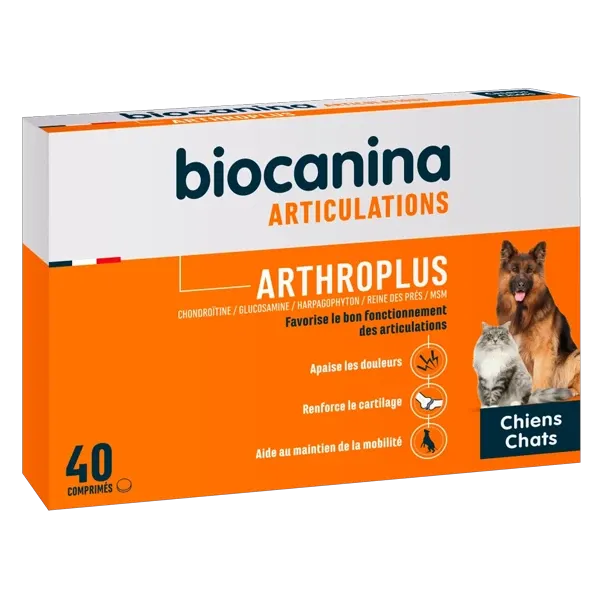
Arthroplus - Joints and mobility - Dogs and cats - 40 tablets - BIOCANINA
In stock
14,92 €
Unavailable in your country
We do not currently ship to your country (États-Unis).
Free shipping from €99
In mainland France
Dispatched within 24h
From the Pharmacie de l'Envigne (86)
Delivery within 2 to 4 days
In mainland France
Secure payment
Encrypted transaction
ANSES-approved pharmacy
Advice from qualified pharmacists
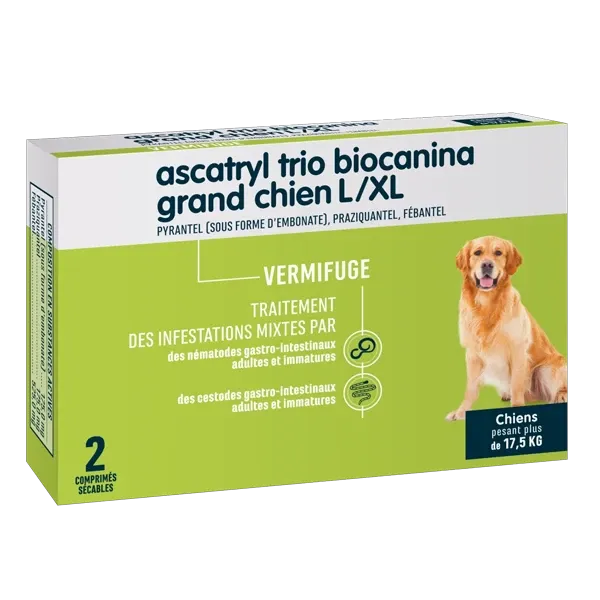
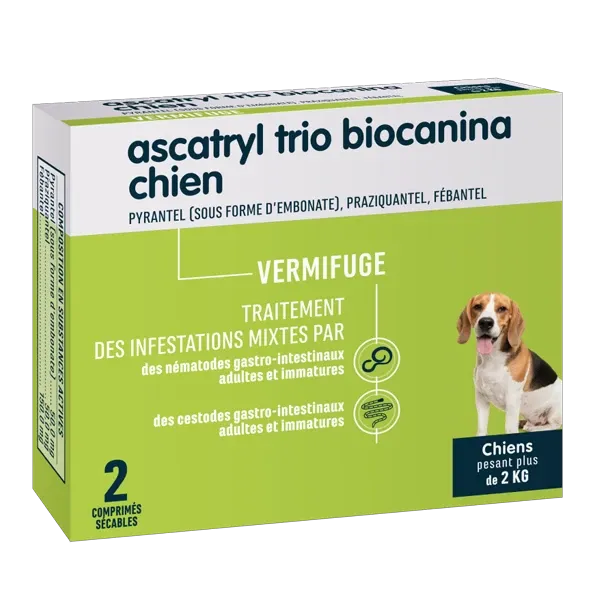
Ascatryl Trio from the BIOCANINA laboratory is a veterinary medicine intended for the treatment of intestinal infestations in dogs.
This dog dewormer acts against the main digestive parasites:
Intestinal worms frequently affect puppies and adult dogs. They can cause digestive disorders, weight loss or a dull coat. Regular deworming therefore limits health risks.
Ascatryl Trio is suitable for dogs weighing 2 to 17.5 kg. Its 2-tablet format allows the treatment to be adapted to the animal's weight.
Ascatryl Trio combines three active substances recognized in veterinary medicine:
This combination allows targeted action against several species of intestinal parasites. Praziquantel acts notably on flatworms. Pyrantel and febantel target roundworms.
This synergy offers a broad spectrum. It covers mixed infestations. In addition, administration in tablet form makes dosing easier.
This is a veterinary medicine. Its use therefore complies with a strict regulatory framework.
In addition, regular deworming protects the dog's digestive health. It also limits contamination of the environment.
Deworming depends on the dog's age and lifestyle. In puppies, the protocol starts early. It is repeated at regular intervals during growth.
In adult dogs, recommendations vary depending on exposure to parasites. An animal living outdoors requires increased monitoring. In addition, a dog in contact with children or other animals must be dewormed regularly.
The veterinarian adjusts the frequency according to the parasitic risk. Preventive deworming remains essential to limit infestations and transmission.
Certain signs may indicate a parasitic infestation. Digestive disorders are sometimes observed. The dog may present diarrhea or vomiting.
Unexplained weight loss is also a warning sign. In addition, a dull coat or a bloated abdomen may appear.
However, the absence of symptoms does not mean the absence of worms. Many infested dogs show no visible signs. This is why prevention with a dog dewormer remains essential.
Garlic is sometimes mentioned as a natural solution. However, its use in dogs requires great caution.
Certain doses can prove toxic. The sulfur compounds in garlic can cause hematological disorders in dogs.
Unlike a medicinal dog dewormer, the efficacy of garlic against intestinal worms has not been scientifically demonstrated to a comparable degree. For this reason, the use of a suitable veterinary medicine remains recommended.
Clinical signs vary depending on the intensity of the infestation. Worm segments are sometimes observed in the stool. This particularly concerns flatworms.
The dog may also rub its hindquarters on the ground. This behavior reflects anal discomfort.
In some cases, digestive disorders appear. Unusual fatigue may also be present. In puppies, a significant infestation can slow growth.
A veterinary consultation allows the diagnosis to be confirmed and the dog dewormer to be adapted.
Regular prevention protects your animal and your household. Choosing a dog dewormer suited to your companion's weight and profile remains essential.
La vermifugation dépend de l’âge et du mode de vie du chien. Chez le chiot, le protocole débute précocement. Il se répète à intervalles réguliers durant la croissance.
Chez le chien adulte, les recommandations varient selon l’exposition aux parasites. Un animal vivant en extérieur nécessite une surveillance accrue. De plus, un chien en contact avec des enfants ou d’autres animaux doit être vermifugé régulièrement.
Le vétérinaire adapte la fréquence selon le risque parasitaire. Une vermifugation préventive reste essentielle pour limiter les infestations et la transmission.
Certains signes peuvent évoquer une infestation parasitaire. On observe parfois des troubles digestifs. Le chien peut présenter des diarrhées ou des vomissements.
Un amaigrissement inexpliqué constitue aussi un signal d’alerte. Par ailleurs, un pelage terne ou un abdomen ballonné peuvent apparaître.
Cependant, l’absence de symptômes ne signifie pas l’absence de vers. De nombreux chiens infestés ne montrent aucun signe visible. C’est pourquoi la prévention par vermifuge chien reste indispensable.
L’ail est parfois cité comme solution naturelle. Toutefois, son usage chez le chien nécessite une grande prudence.
Certaines doses peuvent s’avérer toxiques. Les composés soufrés de l’ail peuvent provoquer des troubles hématologiques chez le chien.
Contrairement à un vermifuge chien médicamenteux, l’efficacité de l’ail contre les vers intestinaux n’est pas démontrée de manière scientifique comparable. Pour cette raison, l’utilisation d’un médicament vétérinaire adapté reste recommandée.
Les signes cliniques varient selon l’intensité de l’infestation. On observe parfois des segments de vers dans les selles. Cela concerne notamment les vers plats.
Le chien peut également se frotter l’arrière-train au sol. Ce comportement traduit un inconfort anal.
Dans certains cas, des troubles digestifs apparaissent. Une fatigue inhabituelle peut aussi être présente. Chez le chiot, une infestation importante peut ralentir la croissance.
Une consultation vétérinaire permet de confirmer le diagnostic et d’adapter le vermifuge chien.