CLÉMENT THÉKAN
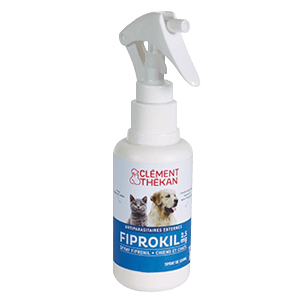
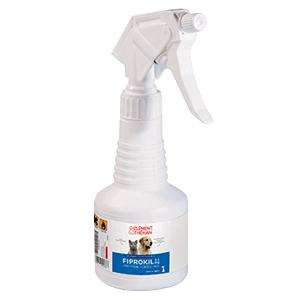
Fiprokil Antiparasitic Spray for Cats and Dogs - 100 ml - CLÉMENT THÉKAN
Plus que 3 en stock
9,50 €
Unavailable in your country
We do not currently ship to your country (États-Unis).
Free shipping from €99
In mainland France
Dispatched within 24h
From the Pharmacie de l'Envigne (86)
Delivery within 2 to 4 days
In mainland France
Secure payment
Encrypted transaction
ANSES-approved pharmacy
Advice from qualified pharmacists
Households with several animals often require a larger pack size. Fiprokil Spray 500 ml meets this need thanks to its large format. This antiparasitic spray effectively treats dogs and cats exposed to fleas and ticks.
The dog antiparasitic and cat antiparasitic acts against external parasites. It helps limit infestations and protect the animal against skin discomfort.
The 500 ml format offers extended autonomy. It suits large-sized animals or environments requiring repeated applications. The antiparasitic spray ensures even coverage of the coat.
Regular antiparasitic treatment limits parasite proliferation. However, it does not replace a wormer when one is indicated. A complete strategy combines external protection and internal parasite management.
In case of doubt or persistent symptoms, it is advisable to consult a veterinarian to adapt the treatment.
The effectiveness of an antiparasitic depends mainly on the targeted parasite and the animal's lifestyle. A dog that goes out a lot needs stricter protection than an animal with little exposure. The 500 ml format is useful if you have several animals or a large-sized one, as it makes it easier to keep up antiparasitic treatment continuity. Nevertheless, effectiveness relies on correct and regular application. In case of doubt, your veterinarian can guide you towards the most suitable solution.
An antiparasitic for cats and dogs fights external parasites, such as fleas and ticks. A wormer targets internal parasites, present in the intestine. Using an antiparasitic spray therefore does not replace worming. Conversely, a wormer does not protect the skin against fleas. A complete approach often combines a dog antiparasitic or cat antiparasitic with a wormer, depending on exposure and age.
An antiparasitic spray applied to the coat can kill fleas present on the animal. The large 500 ml format is convenient for multi-animal households or dogs with dense coats, as it allows for more comfortable treatment. However, antiparasitic treatment must also include the environment if the infestation is established. Without this, eggs and larvae will quickly recontaminate the animal. If the situation persists, veterinary advice remains the best option.
Mange cannot be managed with a fabric spray alone. The diagnosis must first be confirmed, as several conditions look similar. Then, appropriate veterinary treatment is required for the animal, and sanitising bedding completes the care. A fabric spray can be part of the strategy, but it does not constitute a primary treatment. If mange is suspected, consult quickly to avoid spreading.
L’efficacité d’un antiparasitaire dépend surtout du parasite ciblé et du mode de vie. Un chien qui sort beaucoup nécessite une protection plus stricte qu’un animal peu exposé. Le format 500 ml est utile si vous avez plusieurs animaux ou un grand gabarit, car il facilite la continuité du traitement antiparasitaire. Néanmoins, l’efficacité repose sur une application correcte et régulière. En cas de doute, votre vétérinaire peut orienter vers la solution la plus adaptée.
Un antiparasitaire chat et chien lutte contre les parasites externes, comme les puces et les tiques. Un vermifuge cible les parasites internes, présents dans l’intestin. Utiliser un spray antiparasitaire ne remplace donc pas une vermifugation. À l’inverse, un vermifuge ne protège pas la peau contre les puces. Une approche complète associe souvent antiparasitaire chien ou antiparasitaire chat et vermifuge, selon l’exposition et l’âge.
Un spray antiparasitaire appliqué sur le pelage peut tuer les puces présentes sur l’animal. Le grand format 500 ml est pratique pour les foyers multi-animaux ou les chiens à pelage dense, car il permet de traiter plus confortablement. Toutefois, le traitement antiparasitaire doit aussi inclure l’environnement si l’infestation est installée. Sans cela, les œufs et larves recontaminent rapidement l’animal. Si la situation dure, un avis vétérinaire reste la meilleure option.
La gale ne se gère pas uniquement avec un spray textile. Il faut d’abord confirmer le diagnostic, car plusieurs affections se ressemblent. Ensuite, un traitement vétérinaire adapté s’impose pour l’animal, et l’assainissement des couchages complète la prise en charge. Un spray textile peut s’intégrer à la stratégie, mais il ne constitue pas un traitement principal. En cas de suspicion, consultez rapidement pour éviter la propagation.