LABORATOIRES MOUREAU
(2)
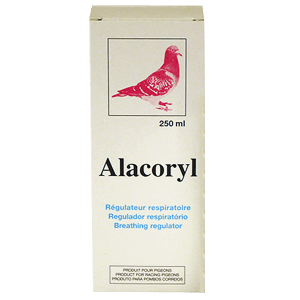
Alacoryl - Respiratory regulator - Pigeons - 250 ml - MOUREAU
In stock
24,92 €
Unavailable in your country

We do not currently ship to your country (États-Unis).
Free shipping from €99
In mainland France
Dispatched within 24h
From the Pharmacie de l'Envigne (86)
Delivery within 2 to 4 days
In mainland France
Secure payment
Encrypted transaction
ANSES-approved pharmacy
Advice from qualified pharmacists
The plumage renewal period is a critical stage in a bird's life. Every year, the bird's body must sustain an intense metabolic effort. Pigeon moulting does not simply consist of shedding worn feathers. It mainly involves entirely rebuilding a new insulating and aerodynamic covering. This phase requires a massive mobilisation of bodily reserves. If the bird lacks essential nutrients, the regrowth will be of poor quality. Dull or brittle plumage may then appear. In addition, fatigue weakens the animal's immune system. It therefore becomes more vulnerable to surrounding diseases. For breeders and enthusiasts, ensuring a perfect moult is an absolute priority. It is the essential condition for preparing future competitions or the breeding season. The laboratory Moureau designed Floramue to specifically address this heightened biological need.
Floramue stands out for its composition targeted at feather biosynthesis. Feathers are mainly made up of keratin, a fibrous protein. To produce this material, the bird needs specific amino acids. The formula contains methionine, an essential sulphur-containing amino acid. The bird's body cannot synthesise it alone in sufficient quantity. This external intake is therefore crucial for the strength and shine of the new feathers.
In addition, this supplement provides a complete blend of vitamins. Vitamin A plays a key role in skin and mucous membrane health. B-group vitamins are directly involved in protein metabolism. They help the bird convert its diet into usable energy. This synergy of ingredients effectively supports the metabolism during pigeon moulting. It helps prevent the frequent exhaustion observed at the end of the season. The product acts as a genuine vitality booster. It thus ensures a smooth seasonal transition for your feathered companions.
The use of this nutritional supplement offers multiple benefits:
The annual major moult is a regular seasonal phenomenon. Generally, pigeon moulting begins towards the end of summer. It mainly extends from July to November or December. This process is triggered by the decrease in day length (photoperiod). However, the first primary feather often falls earlier. This can happen as early as April or May. The peak intensity actually occurs in autumn. This is when the bird renews the largest volume of its feathers. The total duration of the complete process is about five to six months. It is crucial to support the bird throughout this long period.
Feather loss can have two distinct origins. The most common cause is of course physiological. It is the natural renewal of plumage worn out by time and flight. However, abnormal feather loss can signal a health issue. Intense stress can trigger a sudden moult out of season. External parasites, such as chewing lice, also cause localised loss. A diet lacking in protein sometimes leads to feather loss. Finally, certain viral diseases (circovirus) affect the feather follicle. Observe your animal closely. If the skin is irritated or the bird is scratching, consult a veterinarian.
The moulting period corresponds to the bird's sporting and reproductive rest. It immediately follows the young-rearing season. For racing pigeons, it marks the end of competitions. It is a phase of total biological regeneration. The body is, in a way, "under maintenance". Energy is no longer directed towards flight or egg-laying. It is entirely devoted to keratin production. This period spans autumn in our temperate regions. It is the ideal time to administer vitamin and amino acid supplement courses. Good management of this period ensures the success of the following season.
Feather renewal follows a precise biological cycle in four stages. First, the old feather detaches from the dermal papilla and falls out. Then, a new growth phase is activated in the follicle. A sheath appears, a sort of small bluish shaft. This is the second stage, highly vascularised and sensitive. Thirdly, the sheath progressively splits open at its tip. The feather then begins to unfurl and take shape. Finally, the fourth stage is maturation and complete keratinisation. The feather hardens, blood withdraws from the base (calamus) and it becomes functional. Floramue is particularly helpful during the active growth stages.
La grande mue annuelle est un phénomène saisonnier régulier. Généralement, la mue du pigeon débute vers la fin de l'été. Elle s'étend principalement sur les mois de juillet à novembre ou décembre. Ce processus est déclenché par la diminution de la durée du jour (photopériode). Toutefois, la première plume primaire tombe souvent plus tôt. Cela peut arriver dès le mois d'avril ou mai. Le pic d'intensité se situe vraiment à l'automne. C'est à ce moment que l'oiseau renouvelle le plus gros de son volume de plumes. La durée totale du processus complet est d'environ cinq à six mois. Il est crucial de soutenir l'oiseau pendant toute cette longue période.
La perte de plumes peut avoir deux origines distinctes. La cause la plus courante est bien entendu physiologique. C'est le renouvellement naturel du plumage usé par le temps et le vol. Cependant, une perte de plumes anormale peut signaler un problème de santé. Le stress intense peut provoquer une mue brutale hors saison. Des parasites externes, comme les poux mallophages, causent aussi des chutes localisées. Une alimentation carencée en protéines entraîne parfois une perte de plumage. Enfin, certaines maladies virales (circovirus) affectent le follicule plumeux. Observez bien votre animal. Si la peau est irritée ou si l'oiseau se gratte, consultez un vétérinaire.
La période de mue correspond au repos sportif et reproducteur de l'oiseau. Elle suit immédiatement la saison de l'élevage des jeunes. Pour les pigeons voyageurs, elle marque la fin des concours. C'est une phase de régénération biologique totale. L'organisme se met en quelque sorte "en maintenance". L'énergie n'est plus dirigée vers le vol ou la ponte. Elle est entièrement consacrée à la fabrication de la kératine. Cette période s'étale sur l'automne dans nos régions tempérées. C'est le moment idéal pour administrer des cures de vitamines et d'acides aminés. Une bonne gestion de cette période garantit la réussite de la saison suivante.
Le renouvellement d'une plume suit un cycle biologique précis en quatre temps. D'abord, l'ancienne plume se détache de la papille dermique et tombe. Ensuite, une nouvelle phase de croissance s'active dans le follicule. On voit apparaître le fourreau, une sorte de petite tige bleutée. C'est la deuxième étape, très vascularisée et sensible. Troisièmement, le fourreau se déchire progressivement à son extrémité. La plume commence alors à s'épanouir et à prendre sa forme. Enfin, la quatrième étape est la maturation et la kératinisation complète. La plume durcit, le sang se retire de la base (calamus) et elle devient fonctionnelle. Floramue aide particulièrement durant les étapes de croissance active.