Veterinary medicine
BOIRON
(4)
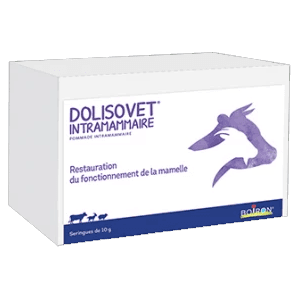
Dolisovet - Intramammary ointment - 52 syringes - BOIRON
In stock
121,58 €
Unavailable in your country
We do not currently ship to your country (États-Unis).
Free shipping from €99
In mainland France
Dispatched within 24h
From the Pharmacie de l'Envigne (86)
Delivery within 2 to 4 days
In mainland France
Secure payment
Encrypted transaction
ANSES-approved pharmacy
Advice from qualified pharmacists
The drying-off period represents a critical stage in the dairy production cycle. Stopping milking often causes an accumulation of milk. This accumulation significantly increases internal pressure. As a result, the udder volume in cows becomes large and sometimes painful for the animal. A congested udder presents increased health risks. It becomes more susceptible to infections such as mastitis.
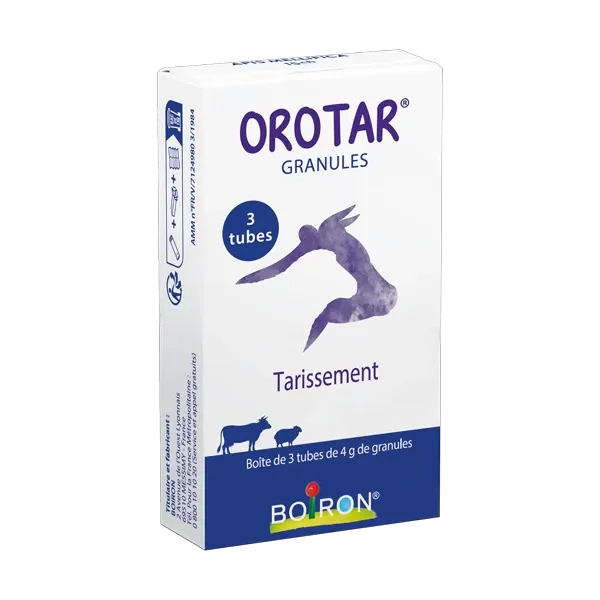
The laboratory Boiron developed Orotar Granulés to address this specific issue. This homeopathic veterinary medicine targets udder conditions related to congestion. It works by supporting the body's natural resorption processes. By targeting congestion, this treatment helps reduce tissue tension. The animal thus regains comfort more quickly. Good management of udder volume from the start of drying-off safeguards the health of the next lactation.
The use of homeopathy in livestock farming offers considerable advantages for herd management. Orotar Granulés respects the animal's body. It is perfectly suited to dairy cows, but also to ewes (sheep) and goats (caprine). The specific formulation of this product combines several recognised homeopathic strains. It notably contains Pulsatilla, Calcarea carbonica ostrearum and Urtica urens. These components work together to soothe local inflammation.
Moreover, this veterinary medicine does not generate chemical residues in the body. This is a major benefit for farmers concerned about the quality of their production. You can integrate it into an overall health protocol without risk of major veterinary drug interaction. It helps ease the delicate transition of weaning or stopping milking. The animal's welfare is preserved, and the stress linked to udder pain is reduced.
Choosing Orotar Granulés to manage drying-off offers multiple practical and economic benefits:
Udder size varies considerably depending on breed, age and stage of lactation. However, the udder volume in cows should gradually decrease after drying-off. At peak lactation, an udder can hold more than 25 litres of milk. During drying-off, it should dry up and involute (shrink). If the volume remains excessive, hard and warm, this indicates abnormal congestion or inflammation. The goal is to achieve a soft, relaxed udder to allow the tissues to regenerate before the next calving.
Anatomically, a cow has a single udder (the pis), divided into four distinct quarters. Each quarter functions independently and has its own teat. It is crucial to monitor each quarter individually during drying-off. Sometimes, the udder volume in cows may seem correct, but a single quarter may remain swollen, indicating a localised problem. Ewes and goats, meanwhile, have an udder divided into two halves with two teats.
To produce milk, a cow must have had a calf. Gestation and calving trigger hormonal lactation. However, once lactation has begun, the cow continues to produce milk as long as it is milked or the calf suckles. Drying-off consists precisely of voluntarily stopping this production about two months before the next calving. This is precisely the moment when the udder volume in cows can become problematic if production does not decrease quickly enough, requiring assistance such as Orotar.
Orotar Granulés uses specific homeopathic strains. Urtica urens is traditionally used to slow milk secretion and reduce oedema. Pulsatilla targets venous congestion and shifting inflammatory states. Calcarea carbonica acts on general metabolism and lymphatic congestion. This combination helps the body resorb fluids accumulated in the udder tissues. By reducing internal pressure, the veterinary medicine relieves pain and promotes rapid involution of the secretory tissue.
La taille d'une mamelle varie considérablement selon la race, l'âge et le stade de lactation. Cependant, le volume de la mamelle vache doit diminuer progressivement après le tarissement. En pleine lactation, une mamelle peut contenir plus de 25 litres de lait. Lors du tarissement, elle doit s'assécher et involuer (rétrécir). Si le volume reste excessif, dur et chaud, cela indique une congestion anormale ou une inflammation. L'objectif est d'obtenir une mamelle souple et relâchée pour permettre aux tissus de se régénérer avant le prochain vêlage.
Une vache possède anatomiquement une seule mamelle (le pis), divisée en quatre quartiers distincts. Chaque quartier fonctionne indépendamment et possède son propre trayon. Il est crucial de surveiller chaque quartier individuellement lors du tarissement. Parfois, le volume de la mamelle vache semble correct, mais un seul quartier peut rester gonflé, signalant un problème localisé. Les brebis et les chèvres, quant à elles, possèdent une mamelle divisée en deux moitiés avec deux trayons.
Pour produire du lait, une vache doit avoir eu un veau. La gestation et la mise bas déclenchent la lactation hormonale. Cependant, une fois la lactation lancée, la vache continue de produire du lait tant qu'elle est traite ou que le veau tète. Le tarissement consiste justement à arrêter volontairement cette production environ deux mois avant le prochain vêlage. C'est à ce moment précis que le volume de la mamelle vache peut devenir problématique si la production ne chute pas assez vite, nécessitant une aide comme Orotar.
Orotar Granulés utilise des souches homéopathiques spécifiques. Urtica urens est traditionnellement utilisé pour freiner la sécrétion lactée et réduire l'œdème. Pulsatilla cible la congestion veineuse et les états inflammatoires changeants. Calcarea carbonica agit sur le métabolisme général et l'engorgement lymphatique. Cette combinaison aide l'organisme à résorber les liquides accumulés dans les tissus mammaires. En réduisant la pression interne, le médicament soulage la douleur et favorise l'involution rapide du tissu sécréteur.