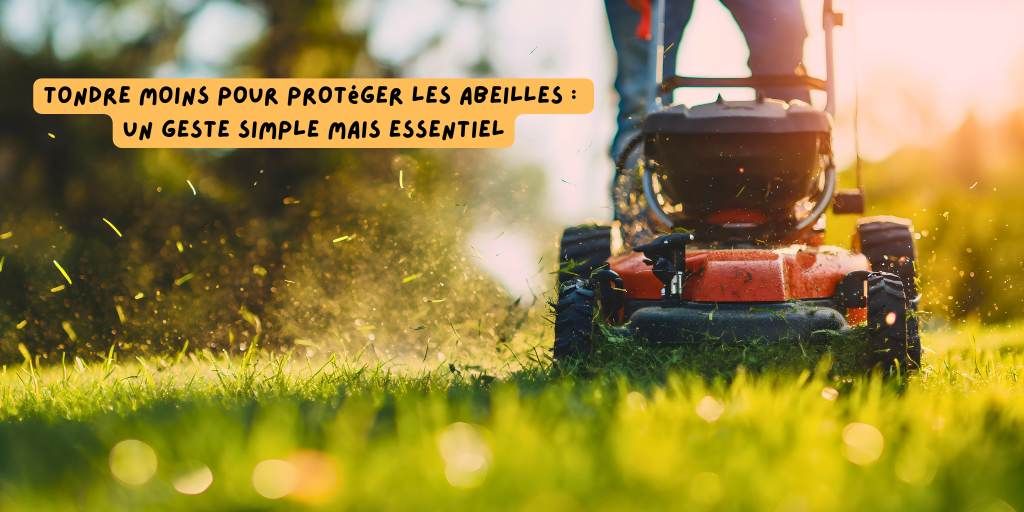
Mow less to protect bees: a simple but essential action

Cécile de Produits-Veto
Pharmacy technician ·

Why mowing less to protect bees really makes a difference
Mowing less to protect bees is a simple gesture. Yet, it has a real impact on local biodiversity. In spring, lawns become an important food resource. They produce nectar thanks to wild flowers. These flowers feed domestic and wild bees. However, too frequent mowing removes these natural resources.
Result: pollinators quickly run out of food.
Adapting your mowing therefore helps to:
- support domestic bees
- protect wild pollinators
- promote local biodiversity
- limit colony stress
This gesture fits perfectly into a responsible ecological approach.
Why traditional mowing weakens bees
Why close mowing is problematic for pollinators
Mowing too short prevents plants from flowering.
Yet, bees depend directly on:
- nectar
- pollen
- wild plants
Without these resources, they must travel further to feed. This tires the colonies. In some cases, it even compromises their survival.
Critical periods for bees in the garden
Spring is a sensitive period.
Colonies restart their activity. They need energy quickly.
Wild flowers then play a major role:
- dandelion
- clover
- daisy
- deadnettle
- ground ivy
These plants are often destroyed by early mowing.
Yet, they are an essential food source.
Simple solutions to adapt your mowing effectively
There are several easy strategies to put in place.
For example:
Mow less often: Mowing every 3 weeks is largely sufficient.
Leave refuge zones: Creating unmowed strips strongly helps biodiversity.
Mow higher: A cutting height above 8 cm promotes flowering.
Mow in alternating zones: This method always keeps a food resource available.
These gestures immediately improve the bees' environment.
Supporting bees in addition to differentiated mowing
Adapting your mowing is effective.
But this gesture can be complemented by suitable nutritional support.
Why bee feeding is sometimes necessary
Certain periods remain difficult despite good garden management:
- unstable weather
- drought
- lack of local flowering
- parasitic pressure
- intensive agricultural environment
In these cases, nutritional support can help colonies.
It helps notably to:
- strengthen energy reserves
- support the queen's laying
- improve overall vitality
- limit the risk of food shortage
Recommended veterinary solutions to support colonies
Nutritional supplements exist to support bees.
They are particularly useful:
- in spring
- after winter
- during drought periods
- during low flowering
You can discover suitable solutions in the category bee feed and nutritional supplement. These products help maintain strong and active colonies.
The advantages of veterinary products to support bees

BeeElixir is a nutritional supplement designed to support bees during sensitive periods.
It is particularly recommended:
- in spring
- after winter
- during unstable weather conditions
- in case of low floral availability
Its benefits:
- support for the general vitality of colonies
- improved resistance to environmental stress
- support for resuming activity
- helps maintain dynamic colonies

BeeStrong Vitalité helps support colonies when their environment becomes less favourable.
It is useful:
- during floral transition periods
- during significant weather variations
- to support weakened colonies
- during activity resumption phases
Its benefits:
- support for colony dynamics
- improvement of general vigour
- support for brood development
- maintenance of regular activity at the apiary

Bee’Full Stimulation Abeille supports the recovery of hive activity during key periods.
It is recommended:
- at the end of winter
- during a late spring
- in case of local nectar deficit
- to support the queen's laying
Its benefits:
- stimulation of laying
- support for brood development
- improvement of spring dynamics
- support for colonies in the restart phase
Frequently asked questions about mowing less to protect bees
Why shouldn't you mow too often in spring?
In spring, lawns produce flowers rich in nectar. Mowing too frequently removes these essential food resources. By letting certain areas grow, you help bees survive and improve local biodiversity.
What mowing height is ideal to protect bees?
A cutting height of about 8 to 10 cm is recommended. It allows wild flowers to develop. It also encourages the presence of useful insects in the garden.
Is it useful to leave an unmown area in your garden?
Yes. An unmown area quickly becomes a refuge for pollinators. It provides nectar and pollen. It also helps protect many beneficial species.
Can you help bees even if you're not a beekeeper?
Yes. Adapting your mowing, planting nectar-rich flowers and setting up water points are already very effective. In addition, supporting colonies with suitable nutrition can help during difficult periods.
Does differentiated mowing attract more harmful insects?
No. It mainly benefits useful insects such as pollinators. It improves the garden's ecological balance and naturally limits certain pests.
To go further
- Find our bee nutrition products
- Discover all our bee care products
- Read our latest article on 5 misconceptions about bees
- Find out more with the article Comment protéger les abeilles ? by Allo Frelons


