Horse: Mud fever, how to support your horse?

Christelle de Produits-Veto
Pharmacy technician ·

Everything you need to know about mud fever and how to act
Let me introduce myself: the name’s Mud, Mud Fever Mud, Dermatophilosis to friends. No relation to France…

You would probably have preferred not to make her acquaintance, but unfortunately she doesn’t ask your opinion before showing up at your place. FranceMud fever, scientifically named dermatophilosis, is no friend to your horse. You can recognise it by the appearance of scabs on the pasterns, lesions on the rump or even the withers.
To be a little more precise, mud fever is a bacterial dermatitis. It mainly affects the horse’s lower limbs, where moisture settles in and lingers. When the skin stays soaked for too long, its natural barrier breaks down. Bacteria already present in the environment then take the opportunity to settle in. So it’s not really a question of “bad luck”, but rather of favourable conditions.
Although it isn’t itchy, Mud Fever can prove painful for your mount. Careful now, don’t put words in our mouth: scabs aren’t necessarily a sign of Mud Fever. To be sure, as always we invite you to book a face-to-muzzle appointment (your mount must of course be present, save your flirting for later) with your vet. It shouldn’t be confused with mange or eczema, which is why a professional diagnosis is essential.
Where do I come from, where am I going? A bit of an intimate question, but fair enough
The origin of Mud Fever is crystal clear. It has absolutely nothing to do with mange mites, but it does develop in a humid, muddy environment. Just like you, your mount isn’t exactly a fan of rain and mud. Mud for a spa treatment, YES, but not under the shoes hooves, NO. If your horses frolic about in muddy paddocks and their legs stay caked after the outing, the mud fever condition is likely to develop.
This phenomenon is made worse when the ground is clay-based or poorly drained. Moisture stagnates, the skin softens and becomes more vulnerable. In horses with thick feathering, water stays trapped for longer. The result: the area never dries completely, and mud fever finds an ideal ground to settle in.
The four seasons of Mud Fever. In spring and summer I leave you in peace… Well, almost
The season plays a role, even if it isn’t the deciding factor. Indeed, mud fever mainly appears in winter and, to a lesser extent, in autumn. However, horses with light-coloured skin can sometimes develop this skin condition, triggered by the sun’s rays, in summer.
In these horses, depigmented skin is more sensitive to outside aggressions. Prolonged sun exposure can weaken the epidermis. Small lesions appear, then become secondarily infected. Summer mud fever remains rarer, but it does exist.
Distinctive signs, how will you recognise me? You’ll recognise me, crust or bust!
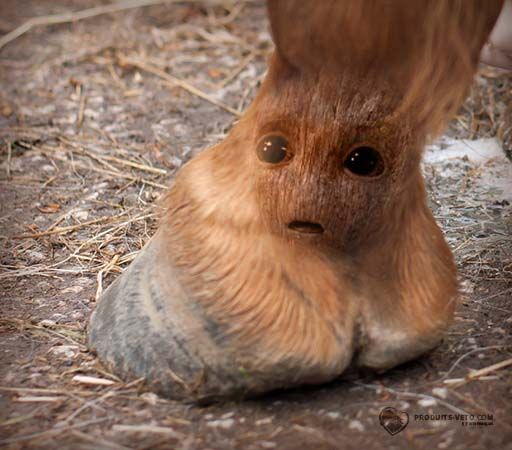
My name’s Scabby
As mentioned before, one of the first signs is the appearance of scabs on the legs, and more particularly on the pasterns. The hair mats together, and the skin becomes “raw” and irritated, triggering significant pain for your horse as it moves.

I’m stuck in the box (or just limping)
Your mount is finding it harder and harder to move around in its box or in the paddocks. This isn’t some trendy new gait picked up on HorseBook (the equine version of Facebook), but pain that’s starting to hinder its movements.

Don’t just blame my back!
Mud fever isn’t confined to the legs and pasterns of your mount. You’ll sometimes find it on the back, the rump and the withers. It shows up as a skin condition, with irritated skin and often sparser hair on and around the affected area.

You wound me!
By making the skin more fragile, mud fever can encourage the appearance of sores where tack rubs against the skin. Be vigilant if you notice reluctance in your mare or stallion when fitting the saddle or the bridle.
Why are some horses more affected than others?
Why me and not the neighbour?
Not all horses develop mud fever with the same ease. Some have thinner skin. Others have a temporarily weakened immune system. Stress, a change in diet or a period of fatigue can also play a role.
Weakened skin withstands moisture less well. And mud fever takes full advantage.
I came, I saw… and I shall not conquer! … Well, more or less
The reign of dermatophilosis is over: forewarned is forearmed, and a warned horse is worth two! Now that the enemy has been identified, we can prepare as best we can to avoid it and/or fight it. A few simple tips will help you prevent mud fever from appearing. As a reminder, this condition’s two banners are none other than dirt and moisture, so:
- Avoid mud build-up: If there’s a trip to the paddock, remember to groom (admit it, you didn’t see that one coming) your horse properly and remove all the mud that builds up on the hooves and pasterns;
- Dry the horse thoroughly: NO, don’t try it, it doesn’t fit in the tumble dryer, and as the name suggests, that’s for laundry. Even so, do take the time to dry your horse as much as possible, from muzzle to hooves;
- Keep warm: Prevention is better than cure, damp weather is mud fever’s best ally. For the season, it’s best to leave your mount warm in a dry, clean box.
Common mistakes
Good intentions that complicate everything
- Cleaning too often with harsh products can strip the skin.
- Pulling off scabs without softening them first can create sores.
- Applying a greasy cream to skin that’s still weeping can trap in moisture.
- Patience remains your best ally. The horse’s skin needs to be cleaned, disinfected, then protected. In that order.
Very educational. Very SEO. Always in your tone.
What do you mean it’s too late?
What, you didn’t follow our advice? Oh, you did? Well, admittedly these are just tips, we’re not magicians, but they do reduce the risk of your horse catching it. If mud fever has well and truly moved into your horse’s legs — or at least if you think so — here are the actions to take:


Mud fever isn’t inevitable. It remains a common but manageable condition. Regular monitoring of the legs, appropriate moisture management and early care often make it possible to avoid severe forms.
And as always, the quicker the intervention, the simpler the recovery.
We hope we’ve given you a few keys to understanding mud fever. Of course with a light touch, even though the subject of dermatophilosis should be taken seriously. We’re certain you’ll take good care of your mare or your stallion so that she (he) can enjoy a good end-of-year holiday season.


