He who varroa last, varroa best!

Christelle de Produits-Veto
Pharmacy technician ·

Varroa Destructor, Maya's worst enemy
After Darth Vader, Sauron, Hannibal Lecter, Freddy Krueger, Biff Tannen or even Gargamel, the new big villain has nothing to envy in his fellow villains. Varroa Destructor, a name that sounds like quite the brute all the same. Let's admit that its size doesn't match its name! On the other hand, it has everything of a big one: it decimates the colonies of our friends the bees. A parasite, nicknamed Sun-Tzu by the foragers, as its battle plan is as cunning as it is devious. Its attack is not frontal, but very much orchestrated. For over 50 years it has been operating at the expense of our honey producers. Let's draw up a portrait of the Machiavellian Varroa together, and give you, the beekeepers, a few tools to fight on equal terms.
A mite in service of the "male"
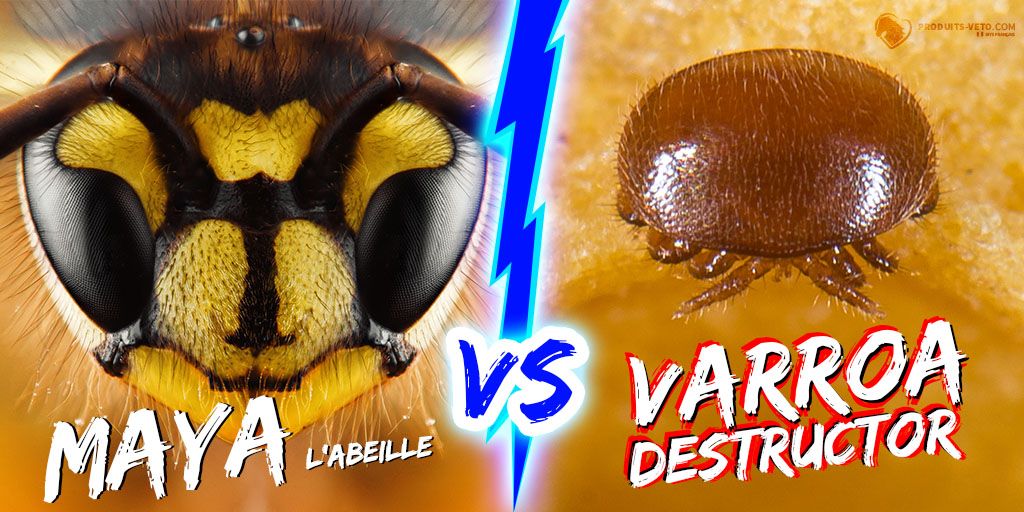
Don't be fooled, it's not a spelling mistake. You know our articles by now, you know we have two passions in life: animals of all kinds and questionable puns. Anyway, moving on! The Varroa is therefore a mite that works to feed itself on the backs of bees. A mite? No, we would even be tempted to say A SHE-mite. In truth, it's a job for a couple, even for a whole varroidae family. To understand this, here is the family tree of Varroa Destructor and the role of each member;
- The female Varroa, aka the warrior mum: She plays a leading role in the conquest of bee colonies. Recognisable by her brown colour and her size of 1,5 à 1,8 mm. This female mite has a double mission: to mate inside a brood cell (around 5 eggs, the first of which is always a male) and to feast on her host's precious blood, clinging on no matter what.
- The "male", not alpha at all: His life comes down to his mission! He is born to carry out his misdeed and dies in the most total indifference. Smaller in size (around 1 mm) and a colour leaning towards yellow/white, the male Varroa will never be found on the bees. To sum up his life: he is born in a brood cell, lets himself be shut in it like a lion in a cage with his sisters, mates with his sisters (sorry, but that's the plain truth), and then dies. Even the daily grind would be a dream to him.
- The daughters / sisters: Once fertilised by the male, who is none other than their brother, inside the brood (where a bee larva is found), the female Varroa will take on their mother's role: destroying colonies and colonising bees.
Varroa rhymes with Dracula
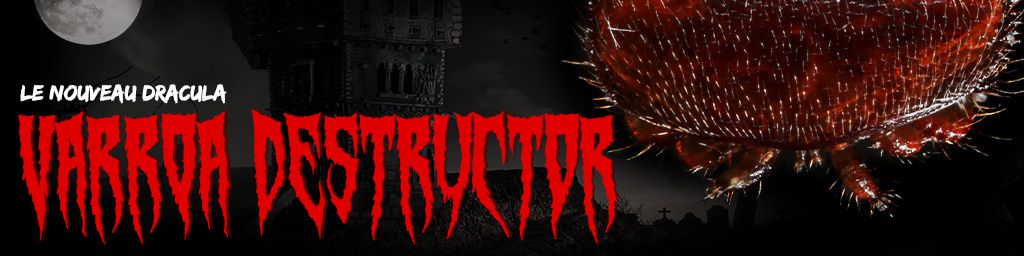
The conquest cycle runs like clockwork! No time to waste, whether at the time of reproduction or of vampirising. As mentioned above, the Varroa's good organisation can wipe out an entire colony in a single season.
- Madam comes to get herself shut inside the brood cell where the bee larva is found;
- She lays eggs, around 5 (2 to 8 to be precise), the first of which is a male;
- This male varroa fertilises the females and then dies;
- When the bee leaves the cell, the females cling on and come out of the cell;
- They feed, just as Count Dracula did in his day, on the blood of the bees;
- Then the female Varroa go back down into the brood cells where a bee larva is found, and…..
That's the life of the Varroa.
What about Maya the Bee in all this?
We've been talking about Varroa destructor for a while now, as if this were a nature documentary devoted to it. Let's not be mistaken, the main subject really is our friend the forager. We need to set the record straight: the aggressor really is the Varroa. What effects on the workers, on the queen, on bees more generally? The Varroa will literally drain its host's blood, depriving it of all its energy, its nutrients and its proteins, while transmitting a virus at the same time. The result: the bee loses immune defences and ages prematurely. Have you seen the 90s film Jack, with Robin Williams? It's roughly the same phenomenon. Entire apiaries can die off starting from a single infected hive. What's more, the production of bees is of poor quality: no one will enjoy this royal jelly.
The worker bee Maya must be saved
We've been talking about Varroa destructor for a while now, as if this were a nature documentary devoted to it. Let's not be mistaken, the main subject really is our friend the forager. We need to set the record straight: the aggressor really is the Varroa. What effects on the workers, on the queen, on bees more generally? The Varroa will literally drain its host's blood, depriving it of all its energy, its nutrients and its proteins, while transmitting a virus at the same time. The result: the bee loses immune defences and ages prematurely. Have you seen the 90s film Jack, with Robin Williams? It's roughly the same phenomenon. Entire apiaries can die off starting from a single infected hive. What's more, the production of bees is of poor quality: no one will enjoy this royal jelly.
The conclusion is clear: something must be done! In order to contain and treat this invasion, several preventive, background or curative actions must be carried out:
The conclusion is clear: something must be done! In order to contain and treat this invasion, several preventive, background or curative actions must be carried out:

Play the 200 episodes of Honey and the Bees on a loop: Install a 1-inch screen with a video recorder in every hive and put in the VHS tape of the whole series. This will give the Varroa invader a heart attack.

Communicate with beekeepers in your area: Send an SMS saying "beekeeper" to 36006… No, sorry. The underlying point is genuine. In the event of an invasion, it's important to warn the beekeepers nearby of the presence of the parasite. Indeed, the Varroa reproduces at supersonic speed, and can very quickly end up in the hives next door. To track the spread of the Varroa, a new mobile app has been launched by the ITSAP (the Bee Institute), for more information it's here VarroAppli;
Develop VSH: No, it's not a new acronym invented for yet another piece of French red tape. VSH stands for Varroa Sensitive Hygiene. According to INRAE, some colonies manage entirely on their own to fight off the Varroa. They expel the parasite from the cell before it is capped, preventing fertilisation. Some studies encourage growing these colonies in order to curb the spread of the mite.
Test for the presence of Varroa in your hive: to find out how present the infestation is / how far it extends, there are several solutions. Some beekeepers set up mesh or perforated boards to see how many male Varroa fall from the frames. The EasyCheck from Laboratoire Veto-pharma also makes it possible to find out the colony's level of infestation.
Treat the invasion: It is advisable to act throughout the year in order to exterminate this parasite. Various compounds are known and recognised for treating this mite and are found in medicinal treatments: thyme, oregano, rhubarb, amitraz,… Whatever your choice, it is not recommended during honey flows, as it can act on the bees and affect the taste of the royal jelly. The breakdown of treatment periods:


* Products compatible with organic farming
Our friends really talk about it well
You can grow your knowledge of Varroa Destructor thanks to websites specialising in foragers:
- Beekeepers, father and son, on the Apiculture.net website: Varroa and varroosis
- The public research institute for agriculture, food and the environment covers the subject: Varroa, the nightmare parasite of domestic bees
- Bee Institute
We hope this article sheds some light on certain grey areas surrounding this parasite, the Varroa. We make no claim to expertise on the subject: you, seasoned beekeepers, surely master it far better than we do. Beginners in beekeeping, take them


